February 4, 2026
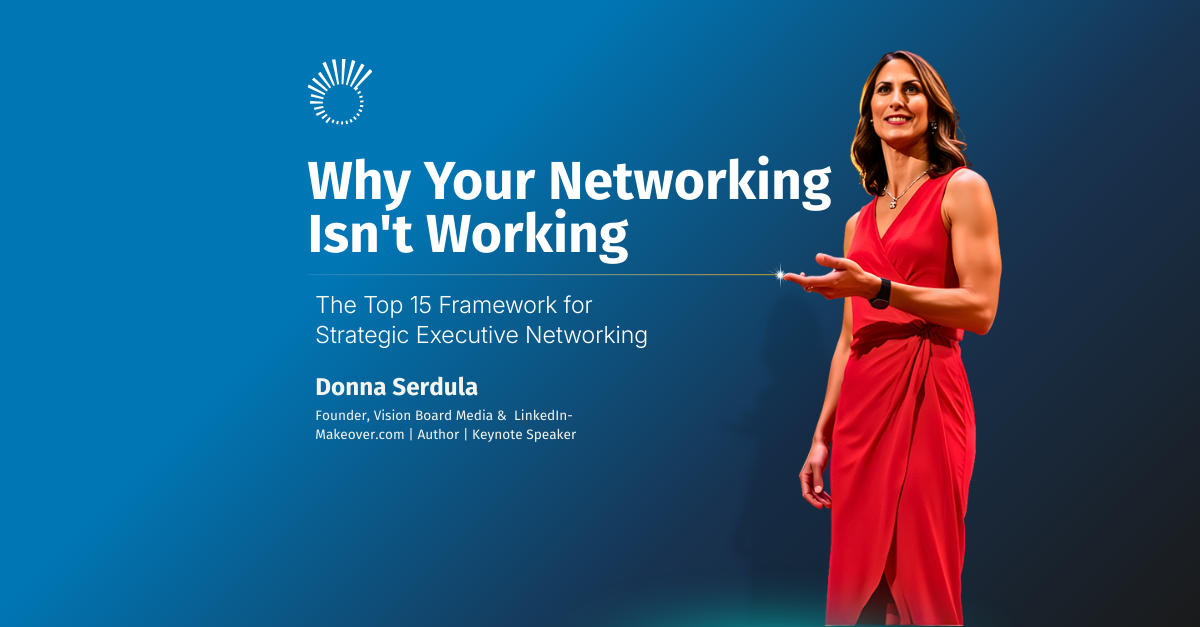
I recently had a conversation that reminded me why most executives fail at networking.
A brilliant scientist, let’s call her Dr. Chen, reached out after hearing me speak at a professional conference. She’d launched her own consulting firm targeting senior scientists in immunology. She was doing everything “right”: attending conferences, joining associations, and showing up at networking events.
And getting absolutely nowhere.
“I feel like I’m going to so many events,” she told me. “I meet similar people, or people who don’t do immunology. I’m trying to figure out which events are important and which aren’t.”
Here’s what I told her: She was asking the wrong question.
Most executives approach networking like they’re collecting business cards at a buffet. They go to events, shake hands, exchange pleasantries, and wonder why nothing happens.
Because that’s not networking. That’s random contact.
Strategic networking, the kind that builds your executive brand and actually generates business, requires a completely different framework.
Twenty years ago, when I was given a sales territory and needed to generate business fast, I didn’t start by attending every industry event I could find.
I did something far more strategic: I identified my Top 15 clients.
How? Research. I looked on LinkedIn. I Googled. I went through association membership lists. I talked to people. I figured out who the key players were in my space.
Then I studied them. I looked at their networks. If this person knows that person, and that person knows this other person, then maybe this third person is important. You start to extrapolate.
This is strategic networking. You’re not hoping to bump into the right people. You’re deliberately identifying them and building a plan to connect.
Once you know who your Top 15 are, the question becomes: Where do they spend their time?
For me, all my clients were in a concentrated geographic area. I found the bar where they hung out after work. I went there. I joined their clubs and associations. I joined the charities they supported. I gave money.
I embedded myself in their community.
Dr. Chen was attending big industry events where everyone already knew each other and had for 20 years. When she’d try to join conversations, entire groups would stop talking and stare at her. She felt like an intruder.
Because she was trying to break into established communities instead of embedding herself strategically in the right ones.
I told her to start smaller. Find the events where her target clients actually show up. Join the organizations where senior scientists in immunology gather. Then show up consistently until she becomes part of the fabric.
“I don’t mind giving gifts,” Dr. Chen told me. “In Chinese culture, you never visit someone empty-handed. But here I feel like I’m bribing people.”
This is where most executives miss the point entirely.
I introduced her to a concept from John Ruhlin’s book Giftology: You give from the heart, without your logo on it.
For years, corporations gave cheap gifts plastered with their branding. Ruhlin changed the game. Give something meaningful. Make it about them, not you.
And here’s the key: A gift doesn’t have to be physical.
You’re giving them visibility, credibility, authority. Things they want but can’t easily get themselves.
This is how you build an executive brand while building your network. You make other people look good, and they remember who did that for them.
“I’m an introvert,” Dr. Chen admitted. “There’s always this voice saying they’re going to reject you, you’ll be embarrassed.”
I’ve given presentations on this exact topic. Here’s what I told her:
Body language overrides everything.
When you walk into a room:
Do these things and you’ll look like you own the room. Most people don’t.
Then just push into conversations: “Hi, my name is Patricia. Can I join you? What are you talking about?”
Most people will welcome you. Some won’t. Some will be rude or dismissive.
Here’s what you need to understand: It’s not you. It’s them.
They’re fighting their own internal battles. They’re hurting. They don’t know any better.
You smile, say “Thank you anyway,” and move on. Don’t carry it with you.
“What kind of person can do this?” Dr. Chen asked me.
Here’s the truth: A rainmaker isn’t born. A rainmaker is made.
That 1% who succeed at this still struggle. They still find it difficult. But they do it anyway.
They walk into awkward situations with confidence (even if it’s fake). They keep picking up the phone even when they keep getting rejected. They do the hard thing.
Your executive brand isn’t built on easy wins. It’s built on showing up when it’s uncomfortable, embedding yourself where it matters, and giving value before you ask for anything in return.
Everything we discussed in that conversation comes back to one thing: Your network IS your executive brand.
People don’t remember your resume. They remember:
This is how executives build authority. Not through events. Through strategic, intentional relationship-building that positions you as someone who adds value.
If you’re a senior executive struggling to build meaningful professional connections—or if you’re launching a consulting practice and need to establish your presence fast—this framework works.
But implementing it requires clarity on your positioning, your target audience, and how you show up both online and in person.
That’s exactly what we do in our Executive Branding engagements. We help you identify your Top 15, craft your positioning, and build the LinkedIn presence that makes you visible to the people who matter.
Looking to transition or elevate your career? Our Career Branding services help professionals at every level develop the strategic network and personal brand that opens doors.
Want to talk strategy? Let’s connect.
A: Start with research. Use LinkedIn to identify thought leaders in your space. Look at association membership directories. Google “top [your industry] executives” or “influential [your specialty] leaders.” Check conference speaker lists. Ask people already in your network who they follow or respect. The Top 15 aren’t always obvious—sometimes they’re the connectors behind the scenes, not the loudest voices.
A: Absolutely. The Top 15 Framework is actually better for introverts because it’s strategic, not scattershot. You’re not working the room at massive events—you’re building intentional relationships with specific people. Focus on one-on-one coffee meetings, smaller gatherings, and adding value through content (articles, introductions, insights). Introverts often build deeper networks because they invest in quality over quantity.
A: It depends on consistency. If you’re actively engaging with your Top 15—reaching out monthly, showing up at the right events, adding value regularly—you’ll start seeing traction in 3-6 months. But this is relationship-building, not transactional sales. Some connections convert quickly; others take years. The key is that you’re building assets (relationships) that compound over time.
A: Networking is the action—meeting people, building relationships, creating connections. Executive branding is the result—how people perceive you, what you’re known for, the reputation you build. Strategic networking builds your executive brand because every interaction reinforces who you are and what value you bring. Your network becomes walking proof of your brand.
A: It’s only awkward if you make it transactional. The gift philosophy from Giftology is about giving meaningful things without expecting anything in return—and importantly, without your logo on it. This could be a book related to their interests, a handwritten note, tickets to something they’d love, or even non-physical gifts like introductions, visibility, or expertise. When done authentically, it’s memorable and builds goodwill.
A: That’s actually ideal. You’re not asking them to mentor you or give you business immediately. You’re adding value to their world. Comment thoughtfully on their LinkedIn posts. Share their content. Attend events where they speak and ask intelligent questions. Write about their work. Introduce them to someone valuable. Over time, you build familiarity and credibility. Remember: even senior executives appreciate people who make them look good.
A: Start by showing up consistently. Join the association. Volunteer for committees (career development, events, content). Contribute without expecting immediate returns. Attend smaller events first where you can build relationships in more intimate settings. Then leverage those initial connections to access larger circles. It takes time—Dr. Chen and I joked she might need five years to become “one of the clique”—but consistency works.
A: Remember the framework: it’s them, not you. Smile, say “Thank you anyway,” and move on to the next conversation. Don’t let one bad interaction derail your confidence. Most people will welcome you if you approach with genuine interest. The few who don’t are dealing with their own issues. Your job is to stay focused on your strategy, not to win over every single person in the room.
A: LinkedIn is where you maintain visibility with your Top 15 between in-person interactions. Connect with them. Engage with their content thoughtfully (not generic “Great post!” comments). Share insights they’d find valuable. Use LinkedIn to research them before you meet, find common connections, and stay on their radar. Your LinkedIn profile becomes part of your executive brand—it should reinforce what you want to be known for. Learn more about optimizing your LinkedIn presence here.
A: Yes. In fact, there’s a saying: “The best time to plant a tree was 20 years ago. The second best time is today.” Start now with the Top 15 Framework. Reach out to old contacts and rebuild those relationships. Be honest: “I’ve been heads-down in [role/situation], and I’m intentionally reconnecting with my network.” Most people appreciate the honesty and will welcome you back. Then build forward strategically from there.
Looking to build a strategic network that elevates your executive brand? Let’s talk. I’d love to help you implement this framework.
Strategy, templates, videos, downloads, and tools — all designed to help you take confident, intentional steps toward the future you want.
Learn More


I LOVE LinkedIn! But I am not endorsed by or affiliated with LinkedIn in any way whatsoever.
There is NO relationship or affiliation with, sponsorship, or endorsement by LinkedIn with this Website.
Absolutely NO content has been authorized by or represents the views or opinions of LinkedIn or LinkedIn personnel.
LinkedIn Makeover is simply a description of a service I provide. My company is called Vision Board Media.
Input your search keywords and press Enter.